Healing frequencies are specific sound frequencies measured in hertz (Hz) that people commonly use during meditation, relaxation, and sound-healing practices. Frequencies such as 174 Hz, 432 Hz, 528 Hz, and 963 Hz are often associated with stress relief, emotional balance, mental clarity, and spiritual well-being. However, scientific evidence supporting these specific healing claims remains limited.
Sound and music can influence mood, relaxation, and emotional experiences. Some research suggests that listening to music and participating in music therapy may help reduce anxiety symptoms. Understanding the difference between traditional frequency associations and scientifically studied benefits can help people make informed decisions about using sound for mental wellness.
What Are Healing Frequencies?
Healing frequencies refer to sound vibrations measured in hertz (Hz), which represent the number of sound wave cycles per second. Different frequencies produce different pitches, ranging from low-frequency sounds to high-pitched tones.
In alternative wellness practices, certain frequencies are associated with relaxation, emotional release, meditation, and spiritual awareness. The Solfeggio frequencies are among the most commonly discussed examples.
People often listen to these sounds through headphones, meditation recordings, singing bowls, tuning instruments, and ambient music.
Although sound can influence emotional experiences and relaxation, there is currently insufficient scientific evidence that individual frequencies can regenerate human cells, remove toxins, cure illnesses, or treat mental health conditions.
Complete Healing Frequency Hz List
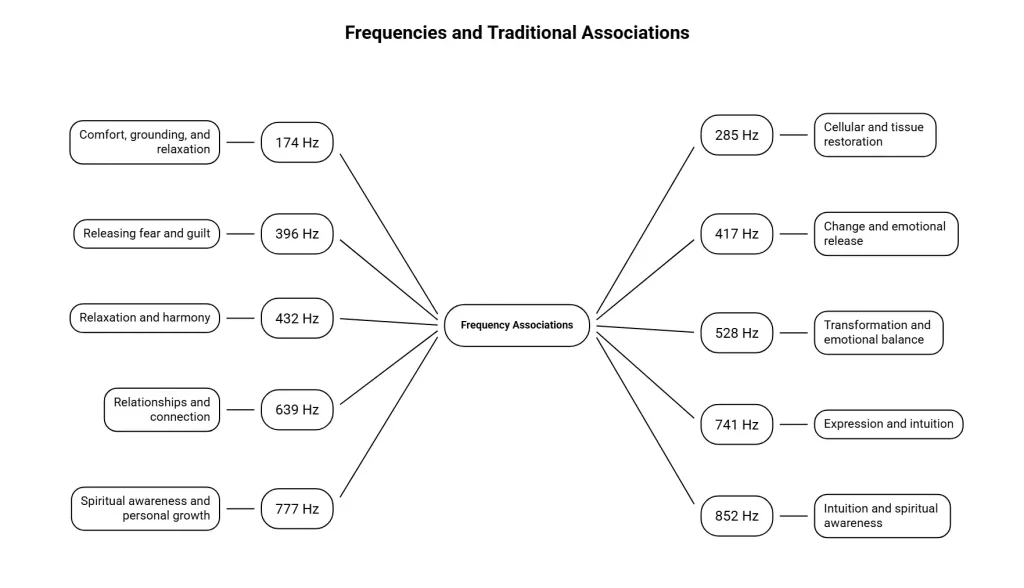
The following table summarizes commonly discussed sound frequencies and their traditional wellness associations.
| Frequency | Traditional association |
|---|---|
| 174 Hz | Comfort, grounding, and relaxation |
| 285 Hz | Cellular and tissue restoration |
| 396 Hz | Releasing fear and guilt |
| 417 Hz | Change and emotional release |
| 432 Hz | Relaxation and harmony |
| 528 Hz | Transformation and emotional balance |
| 639 Hz | Relationships and connection |
| 741 Hz | Expression and intuition |
| 777 Hz | Spiritual awareness and personal growth |
| 852 Hz | Intuition and spiritual awareness |
| 963 Hz | Higher consciousness and unity |
These associations come primarily from alternative sound-healing traditions. They should not be interpreted as scientifically established effects.
The 9 Solfeggio Frequencies and Their Benefits
Solfeggio frequencies are a group of tones commonly used in meditation, sound baths, and alternative wellness practices. Each frequency has a traditional meaning, although clinical research has not established that these tones produce their claimed healing effects.
1. 174 Hz – Relaxation and Grounding
The 174 Hz frequency is traditionally associated with comfort, grounding, and physical relaxation. Some sound-healing practitioners use it during meditation to create a calming listening environment.
People may find low-frequency ambient sounds relaxing, depending on their preferences and listening environment. However, there is no reliable clinical evidence that 174 Hz specifically relieves physical pain or heals the body.
2. 285 Hz – Cellular Restoration
The 285 Hz frequency is commonly associated with cellular regeneration and tissue restoration in alternative sound-healing practices.
Some practitioners believe this frequency supports physical recovery and energetic balance. However, scientific research has not established that listening to 285 Hz can regenerate cells, repair tissues, or accelerate physical healing.
3. 396 Hz – Releasing Fear and Guilt
The 396 Hz frequency is traditionally connected with releasing fear, guilt, and negative emotional patterns.
People sometimes include this tone in meditation sessions focused on self-reflection and emotional awareness.
Listening to calming music may help create space for relaxation and reflection, but 396 Hz has not been proven to eliminate fear, trauma, or negative beliefs.
4. 417 Hz – Supporting Emotional Change
The 417 Hz frequency is often associated with transformation, emotional release, and moving forward from difficult experiences.
In alternative wellness practices, it is used during meditation intended to encourage a fresh perspective and emotional openness.
It is important to understand that listening to this frequency does not independently resolve emotional difficulties. Personal reflection and appropriate mental health support may be more helpful when someone is experiencing persistent distress.
5. 528 Hz – Transformation and Emotional Balance
The 528 Hz frequency is often called the transformation or miracle frequency. It is popularly associated with positive change, emotional balance, and cellular restoration.
Some preliminary studies have investigated whether listening to 528 Hz music may influence stress-related measures and biological markers. However, these findings are not sufficient to establish that the frequency produces cellular repair or reliable mental health benefits.
People may still enjoy 528 Hz recordings as part of a relaxing music routine, provided they understand the limitations of the research.
Also Read: 528 Hz Benefits
6. 639 Hz – Relationships and Connection
The 639 Hz frequency is traditionally associated with relationships, communication, harmony, and social connection.
Some people use it during meditation focused on compassion, understanding, and interpersonal relationships.
Healthy relationships depend on communication, emotional awareness, boundaries, and mutual respect. Listening to a particular frequency cannot independently improve relationship difficulties.
7. 741 Hz – Expression and Intuition
The 741 Hz frequency is commonly associated with self-expression, intuition, and mental clarity.
It is sometimes used during meditation and mindfulness exercises to encourage reflection and concentration.
Claims that 741 Hz removes toxins, cleanses the body, or eliminates negative energy have not been established by scientific research.
8. 852 Hz – Intuition and Inner Awareness
The 852 Hz frequency is traditionally associated with intuition, spiritual awareness, and inner strength.
People may listen to it during quiet meditation or personal reflection.
Although meditation can support relaxation and self-awareness, there is no established clinical evidence that 852 Hz activates intuition or produces specific neurological changes.
9. 963 Hz – Spiritual Awareness and Unity
The 963 Hz frequency is commonly associated with higher consciousness, spiritual connection, and the crown chakra.
It is often included in meditation recordings intended to create a peaceful listening experience.
These spiritual associations are part of alternative wellness traditions rather than established scientific explanations of how the brain functions.
432 Hz vs. 440 Hz: Does It Affect the Brain?
The 432 Hz and 440 Hz frequencies are commonly discussed in alternative music and sound-healing communities.
440 Hz is the standard reference tuning frequency for the musical note A4. Some musicians and wellness practitioners prefer 432 Hz, believing it creates a more natural or relaxing listening experience.
A small crossover pilot study involving 33 participants compared music tuned to 432 Hz and 440 Hz. Researchers observed some differences in heart rate and participant-reported experiences, but the study was too small to establish broad health benefits.
Other studies have also investigated 432 Hz music in relation to anxiety and stress.
The available research is interesting, but it does not establish that 432 Hz has unique brain-healing properties or is universally better for mental health than standard musical tuning.
528 Hz Frequency Benefits: What Research Says
The 528 Hz frequency has received attention in sound-healing communities because of its association with transformation and cellular restoration.
There is some preliminary work on the possible association between it and stress related biological indicators. The evidence is however limited and should not be taken to be evidence of cellular healing.
Much more research has been conducted on mental wellness and music listening and music therapy as a whole than on any specific frequency.
741 Hz Frequency Benefits
The 741 Hz frequency is generally linked to mental clarity, self-expression, and intuition.
You can listen to 741 Hz recordings at home during meditation, journaling or mindfulness sessions.
There is limited clinical evidence of any benefits on cognitive function, detoxification or measurable neurological changes with this frequency.
777 Hz Frequency Benefits
The 777 Hz frequency is sometimes associated with spiritual development, positive energy, personal growth, and inner awareness.
Unlike the nine commonly listed Solfeggio frequencies, 777 Hz is not part of the traditional nine-frequency list.
Its meaning comes mainly from alternative spiritual and numerological interpretations. There is currently insufficient scientific evidence that 777 Hz produces specific psychological or physical health benefits.
963 Hz Frequency Benefits
The 963 Hz frequency is commonly associated with spiritual awareness, meditation, and higher consciousness.
People often use it during quiet reflection or mindfulness sessions.
However, claims about activating the crown chakra or increasing consciousness through this specific sound frequency are not established scientific findings.
Binaural Beats: Delta, Theta, Alpha, and Beta Frequencies
Binaural beats are an auditory phenomenon created when slightly different sound frequencies are presented separately to each ear through headphones. The brain perceives a rhythmic beat corresponding to the difference between the two tones.
They are often categorized according to the perceived beat frequency:
| Brainwave category | Frequency range | Common association |
|---|---|---|
| Delta | 0.5–4 Hz | Deep sleep |
| Theta | 4–8 Hz | Relaxation and meditation |
| Alpha | 8–13 Hz | Calm attention |
| Beta | 13–30 Hz | Active thinking and alertness |
| Gamma | 30–40+ Hz | Cognitive processing and attention |
These ranges describe commonly studied EEG brainwave patterns. They do not mean that listening to a sound automatically produces the corresponding brain state.
Research on binaural beats is ongoing, and results vary depending on the study design, listening conditions, and individual responses.
Can Sound Frequencies Help With Stress and Anxiety?
Music and sound can play a supportive role in emotional well-being. Listening to pleasant or soothing music can assist individuals relax, change their focus, and make a comfortable environment.
A 2025 systematic review and meta-analysis examining 51 studies found that music therapy was associated with reduced anxiety symptoms across different settings.
But the evidence is not related to music therapy, or music-based interventions, but rather to the effectiveness of music in general.
People experiencing ongoing anxiety may benefit from evidence-based approaches such as cognitive behavioral therapy (CBT), mindfulness-based interventions, and professional counseling.
These methods may be combined with sound-based relaxation but should not be used to supplant the use of the appropriate mental health care.
How to Use Healing Frequencies for Relaxation
People interested in exploring sound frequencies can incorporate listening into their daily relaxation routines.
A few practical considerations include:
- Choose music or sounds that feel comfortable and enjoyable.
- Listen at a safe volume to protect your hearing.
- Create a quiet environment with minimal distractions.
- Combine listening with breathing exercises or mindfulness.
- Notice how different sounds affect your mood and comfort.
- Stop listening if a sound causes discomfort, headaches, or increased anxiety.
There is no universally recommended frequency or listening duration that guarantees a therapeutic outcome.
Are Healing Frequencies Scientifically Proven?
The scientific evidence for healing frequencies is mixed and limited. Research supports the potential mental health benefits of music therapy and certain sound-based relaxation interventions, but this does not establish that individual frequencies have unique healing properties.
For example, studies involving 432 Hz and 528 Hz have explored possible physiological and psychological effects, but larger and more rigorous clinical trials are needed.
While the potential for cellular regeneration, toxin elimination, chakra activation, and psychological healing with certain frequencies is suggestive, it lacks scientific verification.
It is helpful to approach sound healing with curiosity while relying on established mental health care when dealing with persistent emotional or psychological difficulties.
Frequently Asked Questions
1. What is the best healing frequency for relaxation?
There is no scientifically established best healing frequency. People may find different types of calming music, ambient sounds, and meditation recordings relaxing depending on their preferences.
2. What is the 528 Hz frequency used for?
The 528 Hz frequency is traditionally associated with transformation, emotional balance, and cellular restoration. However, scientific evidence supporting these specific healing claims is limited.
3. Does 432 Hz music affect the brain?
Some small studies have examined the physiological and psychological effects of 432 Hz music. However, there is insufficient evidence to establish that it produces unique brain-related benefits.
4. What frequency is associated with anxiety relief?
No individual sound frequency has been established as a treatment for anxiety. Research suggests that music therapy and calming music interventions may help reduce anxiety symptoms.
5. What is the difference between Solfeggio frequencies and binaural beats?
Solfeggio frequencies are specific tones traditionally used in alternative sound-healing practices. Binaural beats involve presenting two slightly different tones to separate ears to create a perceived beat frequency.
6. Can healing frequencies replace therapy?
No. Listening to healing frequencies should not replace professional mental health care. People experiencing persistent anxiety, depression, or emotional difficulties should consider seeking support from a qualified mental health professional.
Final Thoughts
Healing frequencies are an interesting part of alternative wellness practices, and music can provide a meaningful way to relax, reflect, and connect with emotions. However, the traditional benefits associated with individual frequencies should be distinguished from scientifically established findings.
Whether someone prefers 432 Hz music, 528 Hz recordings, Solfeggio tones, or binaural beats, the most important consideration is how the listening experience affects their comfort and emotional well-being.
For people experiencing ongoing stress, anxiety, or emotional challenges, professional counseling can provide structured, evidence-based support. Sound and music may complement a broader self-care routine, but lasting mental wellness involves more than listening to a particular frequency.
Take a positive step toward better mental health. Connect with PS-ITS Counseling to explore professional counseling support for your emotional and mental wellness needs.
Also Read:
Best Frequency for Brain Healing
Sound Therapy for PTSD Healing Through Vibrations